
How it works
Deterministic first. The judgment stays with you.
How FinOps Brain reconciles a client's Purchase Register against GSTR-2B, and hands you a short queue of decisions instead of a spreadsheet.
- 1
Upload the Purchase Register and GSTR-2B.
Bring in the client's Purchase Register and their GSTR-2B for the period. Do one client, or the whole book at once. The period, the GSTINs, and the values are read in as they are, nothing is altered on the way in.
- 2
The engine reconciles the bulk.
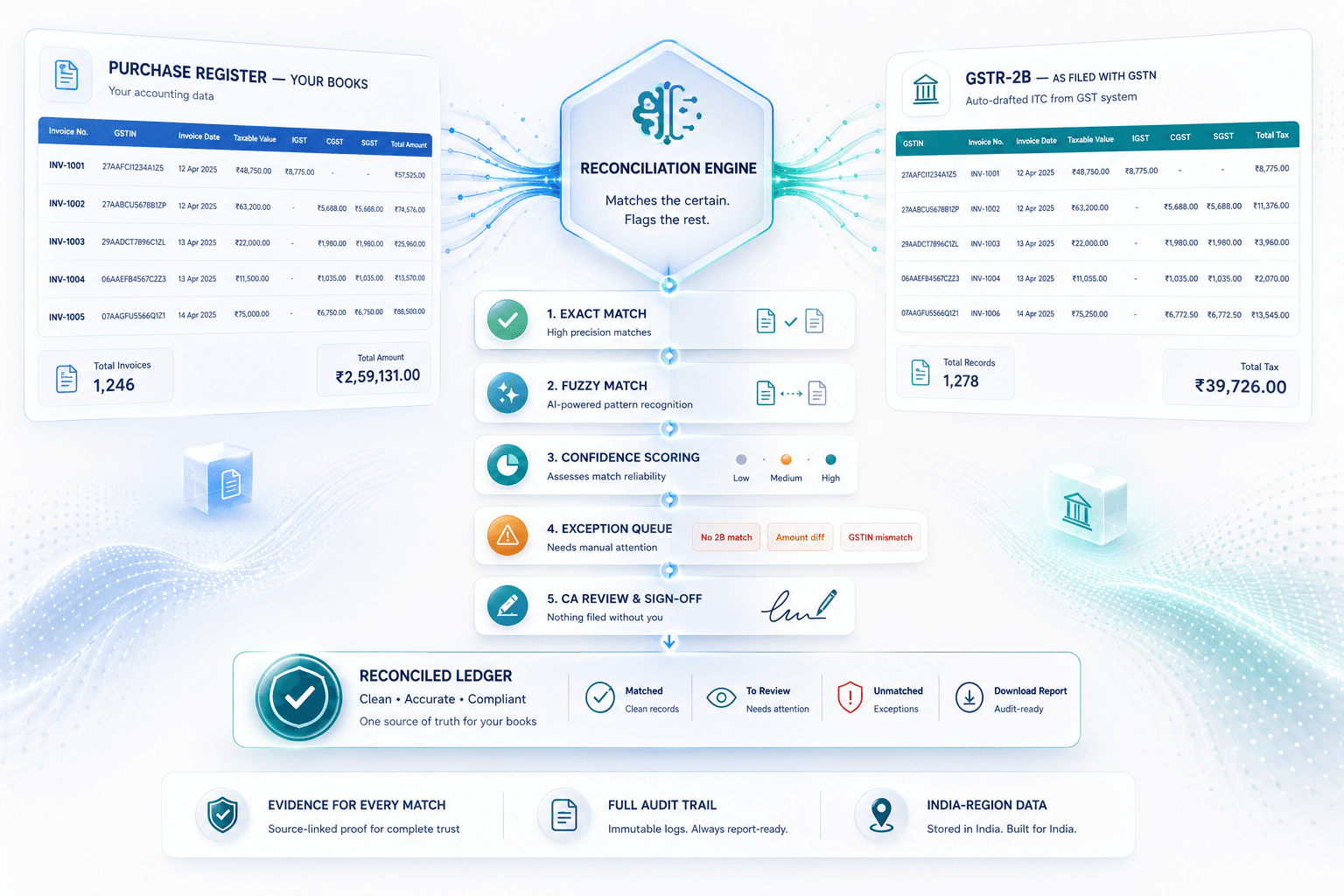
Matching runs as a cascade, cheapest and most certain first:
- Exact match: invoices that agree on GSTIN, number, period, and value are reconciled outright.
- Fuzzy match: near-matches (a transposed invoice number, a rounding gap, a date on the boundary) are paired and flagged for a look.
- Confidence scoring: anything the first two can't settle is scored, and only what falls below the threshold is raised as an exception.
The rule we do not break: the AI does not decide what gets filed. It reconciles what is unambiguous and surfaces what is not.
- 3
You review the exceptions.
What's left is a ranked queue, short, because the bulk is already cleared. Each exception carries:
- A reason: no 2B match, amount difference, GSTIN mismatch, or supplier not filed.
- The evidence: the two records side by side, the exact field that differs, the amount at stake.
- A suggested action: accept, correct, or hold, that you take or override in one click.
- 4
You sign. Everything is logged.
When the queue is clear, you file with your sign-off. Every match the engine made, every correction you entered, and every approval is recorded and attributable, so if a figure is ever questioned, the trail is already there.
The flow at a glance
From two files to a reconciled, review-ready ledger.
What stays true, regardless of the feature list.
You review and sign every return.
Nothing is filed without you.
Client data is stored in India.
In line with how CA firms are expected to hold it.
Every action is audit-logged.
Attributable and reviewable.
Your data never trains shared models.
It stays yours.